Sep 9, 2026
Updates
From Planning to Execution: A Connected Approach to Real-Time Anti-Collision
Anti-collision is a low-probability, high-consequence risk.
Most wells will never experience a collision. But when one does occur, the consequences can extend far beyond the cost of the well - potentially resulting in loss of well control, damage to producing assets, environmental impact and, most importantly, serious risk to people.
Managing that risk has always been a fundamental part of well planning. But the anti-collision picture does not stop changing once drilling begins.
As the well progresses, new surveys are taken, the actual wellbore position develops and the relationship between the active well and surrounding offsets continues to change.
That means anti-collision needs to remain connected to the well throughout execution.
Innova Vantage brings the data, calculations, rules and visualization required for anti-collision into a continuously updated operational workflow - from planning through drilling.
Keeping the anti-collision picture current
A planned trajectory provides the starting point. During execution, however, anti-collision decisions need to reflect where the well is actually being drilled.
Innova Vantage continuously updates the anti-collision picture as new survey data becomes available, allowing drilling and engineering teams to monitor wellbore proximity, uncertainty and collision risk against the latest available information.
At the center of this workflow is an automated calculation cycle that runs every two minutes.
Each cycle begins with the latest reference-well surveys. Vantage calculates the projected wellbore position and associated uncertainty, identifies the relevant offset wells and prepares the trajectory data for scanning.
The system then performs the proximity scan, calculates Separation Factor and Collision Risk, and evaluates the results against the operator’s configured anti-collision rules and thresholds.
The workflow can be summarized as:
Latest surveys → projection → offset selection and scan → Separation Factor & Collision Risk → operator rules → alerts → updated results
Results are stored, alerts are evaluated and the latest anti-collision picture becomes available throughout Vantage.
Two minutes later, the process runs again.
This creates a continuously evolving view of collision risk that follows the well as it is drilled, rather than relying on a calculation performed at a single point in time.
Bringing the anti-collision data together
An anti-collision calculation is only as current and reliable as the data behind it.
The challenge is that the information required to build that picture rarely originates from a single system.
Well plans and offset trajectories may be stored in planning applications or EDM databases. Surveys may arrive directly from the directional drilling provider. Corrected surveys may come from specialist survey correction services, while EDR systems provide live drilling information, well status and additional survey data.
Rather than asking operators to change those existing workflows, Innova Vantage connects the relevant data sources and brings them together to drive the anti-collision process.
Source systems remain the source of record. Vantage becomes the layer that connects that information, applies the required calculations and rules, and makes the resulting anti-collision picture available operationally.
This open integration approach also allows operators to work with their existing technology ecosystem, rather than requiring every part of the anti-collision workflow to originate within a single application.
From calculations to operational visibility
Running the calculation is only one part of effective anti-collision management.
Teams also need to be able to understand what the results mean, identify developing risks and investigate the relationship between the active well and surrounding wellbores.
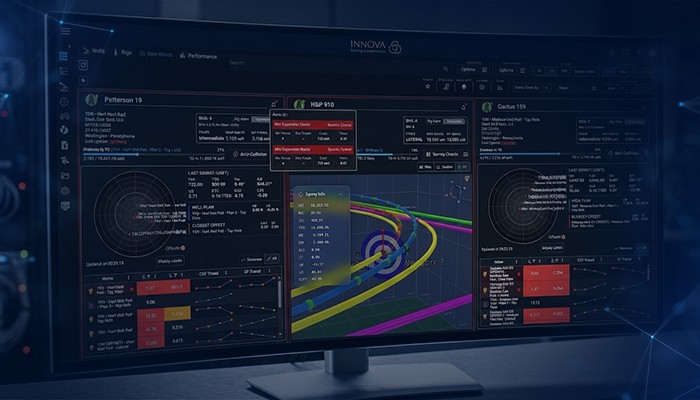
Innova Vantage provides multiple ways to interrogate and visualize the anti-collision picture, including:
Interactive 3D wellbore visualization
Plan and Section Views
Travelling Cylinder plots
Centralized anti-collision dashboards
Automated alerts
Anti-collision reports and automated reporting
This gives different teams access to the same underlying anti-collision calculations in the format most useful to them.
Instead of manually pulling information together from multiple sources to understand the current situation, drilling and engineering teams can move from a high-level view of the operation into the detail behind an individual well, offset or proximity event.
Applying operator-defined rules
Anti-collision is not simply about calculating the distance between two wellbores.
Uncertainty, separation criteria, well type, survey quality and the operator’s own risk-management policies all influence how results should be interpreted.
Innova Vantage supports ISCWSA Rev. 4 and Rev. 5 error models, WPTS Separation Rule, Collision Risk calculations and operator-defined warning criteria, allowing the workflow to reflect established industry methodologies alongside an operator’s own anti-collision policies.
Different anti-collision policies can be configured for different well types and operational scenarios, with defined thresholds used to evaluate the results during each calculation cycle.
This means the automated workflow is not simply asking how close are these wells?
It is evaluating that proximity within the context of the uncertainty models and rules the operator has chosen to apply.
Consistency starts with the uncertainty model
As operations scale across multiple rigs, wells, directional drilling providers and survey technologies, another challenge emerges: consistency.
The anti-collision calculation needs to reflect the correct uncertainty associated with the survey tools being used. Maintaining control of those tool codes and error models across a large well database can therefore become an important part of the overall anti-collision process.
Vantage provides a centralized library for managing tool codes, error models and survey programs across the operation.
Operators can define and maintain approved tool codes centrally, identify which wells are assigned to each model and track the survey programs being applied throughout the well database.
An auditable history also provides visibility into both current and previously applied tool codes, helping teams verify that approved uncertainty models have been applied consistently.
Vantage supports ISCWSA Rev. 4 and Rev. 5 error models, gyro models, XCL terms and inclination-only wells, with calculations validated against established industry implementations.
The result is greater control over one of the fundamental inputs behind the anti-collision calculation.
Anti-collision connected to the well
Anti-collision has traditionally involved multiple systems, datasets and stages of the drilling process.
The opportunity is not simply to perform another calculation. It is to connect those pieces into a workflow that remains active as the well progresses.
Innova Vantage brings together well plans, offsets, surveys, uncertainty models, operator-defined rules, automated calculations, visualization, alerts and reporting within one connected environment.
The underlying data can continue to come from the systems and service providers an operator already uses. Vantage connects that information and turns it into a continuously updated operational picture of collision risk.
Because the probability of a collision may be low. The consequence isn’t.
And as the wellbore changes, the anti-collision picture needs to change with it.
Innova Vantage keeps anti-collision connected to the well - from planning through execution.
